Last updated on September 20th, 2026 at 01:56 pm
Converting watts to lumens helps you compare lighting performance beyond electrical power alone. Our watts to lumens calculator estimates light output based on wattage and luminous efficacy. Enter the power consumption and lumens-per-watt value to calculate the expected lumen output, then use the result to compare LED bulbs, fixtures, and other lighting products more effectively.
Watts to Lumens Calculator
Estimate light output in lumens from bulb wattage and lighting efficacy. Select a lighting technology or enter a custom efficacy value.
Lighting Specifications
Actual efficacy varies by product, design, driver, operating conditions, and manufacturer specifications.
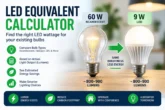
A 60-watt incandescent bulb and a 9-watt LED can produce roughly similar amounts of light. So if you're replacing an old bulb, wattage alone won't tell you how bright the new light will be. That's where lumens matter.
Use the watts to lumens calculator above to estimate light output from electrical power and luminous efficacy. There isn't one universal watts-to-lumens conversion. Different lighting technologies produce different amounts of light from the same electrical input.
Watts vs. Lumens: What's the Difference?
Watts (W) measure electrical power consumed by a light source. Lumens (lm) measure total visible light output. A higher wattage therefore does not automatically mean a brighter modern light. Luminous efficacy, measured in lumens per watt (lm/W), connects electrical input with light output.
How to Convert Watts to Lumens
The basic relationship is:
Lumens = Watts × Lumens per Watt.
For example, a 10-watt LED producing 100 lm/W gives an estimated 1,000 lumens. The calculation is simple. The difficult part is choosing a realistic efficacy value.
Why There Is No Fixed Watts-to-Lumens Conversion
A common mistake is assuming that 1 watt equals a fixed number of lumens. It doesn't. The relationship changes with the light source, LED design, driver, optics, thermal management, operating conditions, and overall luminaire design.
Don't Assume More Watts Means More Light
A higher-wattage LED may produce more light, but that is not guaranteed. Consider LED efficiency, driver efficiency, thermal management, optics, operating temperature, and product design.
How to Choose an LED by Lumens Instead of Watts
If you are replacing an existing bulb, start with the light output you need. Then check lumen output, wattage, lm/W, color temperature, CRI, beam angle, dimmability, voltage, base type, and fixture compatibility.
Key Lighting Measurements
| Measurement | What it tells you | Unit |
| Wattage | Electrical power consumed | W |
| Lumens | Total visible light output | lm |
| Luminous efficacy | Light produced per watt | lm/W |
| Lux | Light reaching a surface | lx |
| Color temperature | Appearance of the light | K |
| CRI | Color rendering quality | 0–100 |
Watts to Lumens Conversion Chart
| Wattage | 80 lm/W | 100 lm/W | 120 lm/W | 140 lm/W |
| 5 W | 400 lm | 500 lm | 600 lm | 700 lm |
| 7 W | 560 lm | 700 lm | 840 lm | 980 lm |
| 9 W | 720 lm | 900 lm | 1,080 lm | 1,260 lm |
| 10 W | 800 lm | 1,000 lm | 1,200 lm | 1,400 lm |
| 12 W | 960 lm | 1,200 lm | 1,440 lm | 1,680 lm |
| 15 W | 1,200 lm | 1,500 lm | 1,800 lm | 2,100 lm |
| 20 W | 1,600 lm | 2,000 lm | 2,400 lm | 2,800 lm |
| 30 W | 2,400 lm | 3,000 lm | 3,600 lm | 4,200 lm |
| 40 W | 3,200 lm | 4,000 lm | 4,800 lm | 5,600 lm |
| 50 W | 4,000 lm | 5,000 lm | 6,000 lm | 7,000 lm |
| 60 W | 4,800 lm | 6,000 lm | 7,200 lm | 8,400 lm |
| 100 W | 8,000 lm | 10,000 lm | 12,000 lm | 14,000 lm |
These are mathematical estimates, not guaranteed product ratings. For an actual bulb, check the manufacturer's stated lumen output.
FAQs
Can you directly convert watts to lumens?
Not with one universal conversion factor. You need the lighting technology or luminous efficacy.
How many lumens is 10 watts?
At 100 lm/W, a 10-watt light produces approximately 1,000 lumens. At 120 lm/W, it produces approximately 1,200 lumens.
How many lumens is a 60-watt bulb?
A traditional 60-watt incandescent reference is approximately 800 lumens.
Is a higher wattage bulb brighter?
Not necessarily. Wattage measures electrical power, not light output. Compare lumens.
Are LED watts and incandescent watts equivalent?
No. Compare the LED lumen output with the light output you need rather than matching wattage.
Final Thoughts
Watts tell you how much electrical power a light uses. Lumens tell you how much visible light it produces or bulb brightness. Lumens per watt connects the two. Use the watts to lumens calculator for an estimate, but when selecting an actual LED product, use the manufacturer's tested lumen output whenever available.
Start with the lumens you need, then compare wattage, efficacy, color, beam distribution, CRI, voltage, and fixture compatibility.