Last updated on September 20th, 2026 at 01:13 pm
Bulb Wattage Calculator
Calculate bulb wattage from voltage and current or enter a known wattage to estimate energy use and electricity costs.
Calculation Method
Bulb Specifications
Energy Consumption
Why Calculate Bulb Wattage?
Knowing how much power your lighting system uses helps you make better decisions about energy consumption and operating costs.
- Estimate the electrical load of a lighting installation
- Calculate daily and monthly energy consumption
- Estimate lighting electricity costs
- Compare different bulb and LED wattages
- Identify opportunities to reduce energy consumption
- Plan lighting upgrades for commercial facilities
- Evaluate the potential impact of energy-efficient lighting
For large facilities, even a small reduction in the wattage of each fixture can produce meaningful savings when thousands of lights operate for long hours.
How to Calculate Bulb Wattage
Electrical power is measured in watts (W). For a basic electrical load, power can be calculated using voltage and current:
Power (W) = Voltage (V) × Current (A)
Example:
If a lighting load operates at 120 volts and draws 0.5 amps:
120 V × 0.5 A = 60 W
The electrical load is therefore approximately 60 watts.
For AC lighting systems where power factor is relevant, the relationship can also be expressed as:
Power (W) = Voltage (V) × Current (A) × Power Factor
The appropriate calculation depends on the type of electrical system and equipment being evaluated.
What Affects Lighting Electricity Costs?
· Bulb Wattage
Higher-wattage bulbs generally consume more electrical power when operated for the same amount of time. For example, a 40W bulb uses twice the electrical power of a 20W bulb under comparable operating conditions. Replacing inefficient lighting with lower-wattage fixtures that provide the required light output can reduce energy consumption.
· Operating Hours
The longer a bulb operates, the more electricity it consumes. A 20W bulb operating for 12 hours per day uses more energy than the same bulb operating for 6 hours. Lighting controls such as occupancy sensors, timers, daylight controls, and scheduling systems can help reduce unnecessary operating hours where appropriate.
· Number of Bulbs
The number of fixtures has a direct effect on total lighting consumption. For example, 1,000 fixtures operating at 20W each have a connected lighting load of 20,000W, or 20 kW. Reducing fixture wattage across a large installation can therefore have a significant effect on total energy consumption.
· Electricity Rate
Your electricity tariff determines how much each kilowatt-hour costs. Two facilities using the same amount of electricity can have different lighting costs because their electricity rates and billing structures differ.
· Lighting Controls
Lighting controls can reduce energy consumption by limiting unnecessary operating hours. Depending on the application, occupancy sensors, timers, dimming systems, and daylight-responsive controls can help reduce lighting demand.
Watts vs. Lumens: What's the Difference?
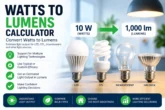
Wattage and lumens measure different things.
| Measurement | What It Tells You |
| Watts (W) | Electrical power consumed |
| Lumens (lm) | Visible light produced |
| Lumens per watt (lm/W) | Lighting efficiency |
A higher-wattage bulb does not automatically produce more useful light. Modern LED technology can produce substantial light output using considerably less electrical power than older incandescent or halogen light technologies.
When comparing lighting products, consider both lumens and wattage rather than using wattage alone to determine brightness.
Common Bulb Wattages
| Type of Bulb | Typical Wattage | General Use |
| LED Bulb | 4 to 20 W | General lighting |
| CFL Bulb | 8 to 25 W | General indoor lighting |
| Halogen Bulb | 20 to 100 W | Accent or general lighting |
| Incandescent bulb | 25 to 100+ | Traditional lighting |
FAQs
Does higher wattage mean a brighter bulb?
Not necessarily. Wattage measures electrical power consumption, while lumens measure visible light output.
For example, a modern LED bulb may produce similar light output to an older incandescent bulb while consuming significantly fewer watts.
For lighting comparisons, look at:
- Lumens → light output
- Watts → power consumption
- Lumens per watt → efficiency
What is bulb wattage?
Bulb wattage is the amount of electrical power a bulb consumes while operating, measured in watts (W).
How many watts does a light bulb use?
The wattage depends on the bulb type and model. Common household and commercial bulbs can range from a few watts for efficient LEDs to more than 100 watts for some traditional lamps.
What is the difference between bulb wattage and lumens?
Bulb wattage measures the total electrical power consumed by a fixture, while lumens measure the actual amount of visible light produced.
How much electricity does a 100 W bulb use?
0.1 kilowatt-hours (kWh) of electricity for every hour of continuous operation.
Does higher wattage mean brighter bulb?
No, it indicates higher power consumption.
What power factors should I use for a light bulb?
Use a power factor of 1.0 for simple resistive incandescent bulbs.
Final Thoughts
Calculating bulb wattage gives you a practical way to understand lighting power consumption, estimate electricity costs, and compare lighting technologies. Of course, you must choose a bulb that meets the recommended light standards.
For commercial facilities, evaluating wattage, lumens, operating hours, fixture quantity, electricity rates, and lighting controls together provides a more complete picture of lighting performance and operating costs.
Use the Bulb Wattage Calculator to estimate your lighting requirements, then compare efficient LED options based on both light output and energy consumption.